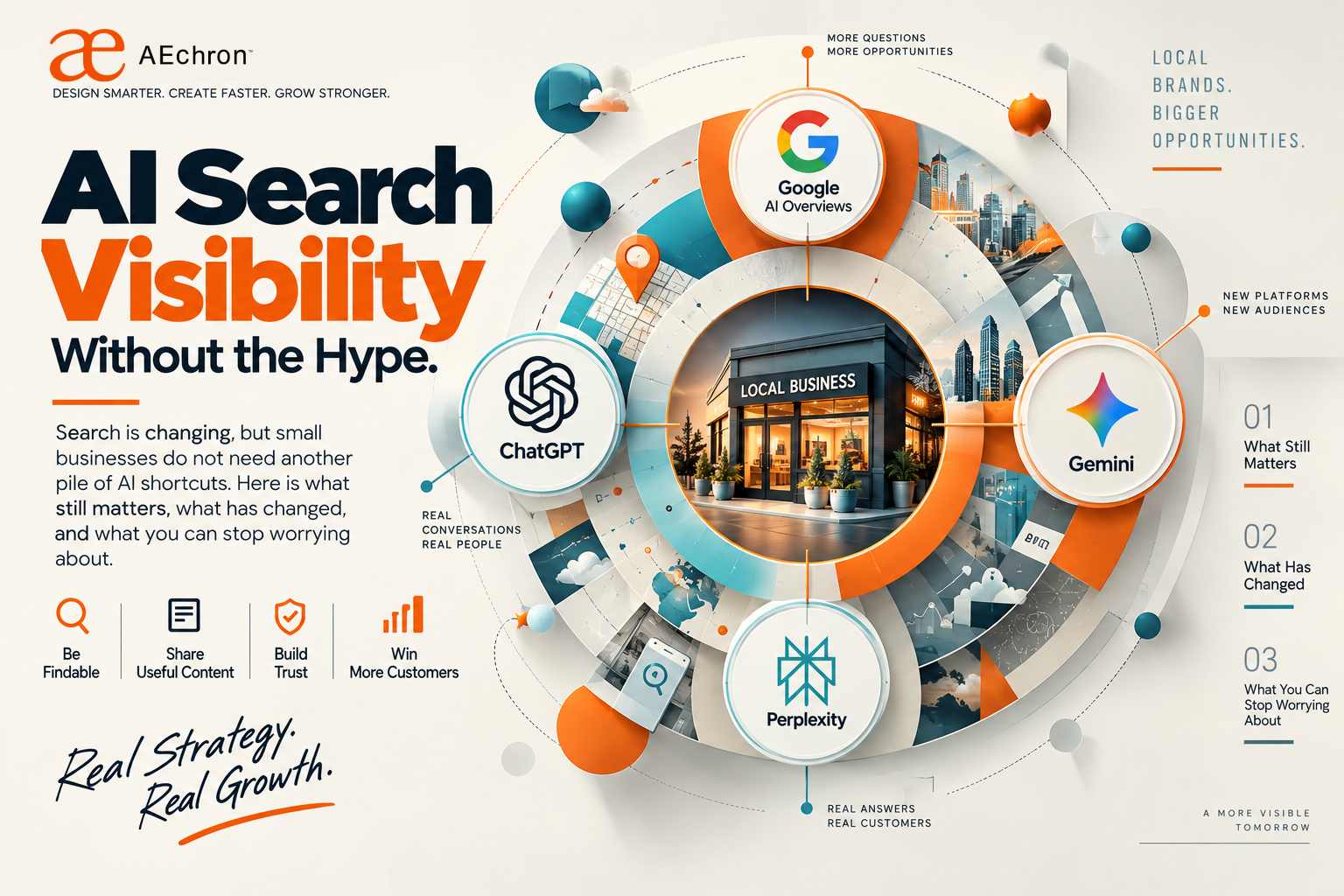
Search is changing quickly. Customers are no longer relying only on a list of blue links. They are asking longer questions, reading AI-generated summaries, comparing businesses inside answer engines, and sometimes making decisions before visiting a website.
That shift has created a new wave of advice about AEO, GEO, AI optimization, special files, structured data, and content written specifically for machines.
Some of that advice is useful. Some of it creates more work without improving visibility.
Google's recent guidance offers a simpler message: businesses do not need to rebuild their entire website for AI search. Strong SEO fundamentals, original information, clear business details, useful content, and a trustworthy website still provide the foundation.
SEO still matters in AI search
AI Overviews and AI Mode may look different from traditional search results, but they still rely on Google's search index and core ranking systems. Google's official guide to generative AI features in Search says the same foundational SEO practices remain relevant.
That means a website must still be accessible to search engines, eligible for indexing, technically functional, helpful to visitors, clear about what the business offers, connected through crawlable internal links, and supported by accurate information.
A business that cannot be understood by traditional search systems is unlikely to become more visible simply by adding a few AI-focused terms or files.
This is why SEO, AEO, GEO, AIO, and SXO should not be treated as disconnected marketing strategies. They are different ways of thinking about one larger goal: helping people and search systems understand, trust, and use your information.
You do not need a separate page for every possible question
AI systems can expand a user's original question into several related searches. Google calls this process query fan-out.
This does not mean a business should create dozens of nearly identical pages targeting every variation of a keyword. A better approach is to create one strong page that answers the main question thoroughly and naturally addresses the questions a customer might ask next.
For example, a local contractor does not need separate pages for every variation of how much a service costs, how long it takes, whether it is available nearby, what a customer should expect, and how to choose a provider. A well-organized service page can answer those questions while remaining useful and readable.
Google recommends creating valuable, non-commodity content rather than publishing large volumes of information that simply repeat what already exists online.
llms.txt is not an AI-search ranking shortcut
An llms.txt file may be useful for certain tools or systems, but Google states that it does not use the file for Google Search or its generative AI features.
Having one should not hurt your website. It can provide a concise description of your business and important pages for systems that choose to read it. But it should not replace:
- A clear website structure
- Strong service pages
- Accurate titles and descriptions
- Useful internal links
- A current sitemap
- Original content
- Search Console monitoring
If the website itself is unclear, an additional text file will not solve the underlying problem.
Structured data helps, but there is no special AI schema
Structured data can help Google understand details such as your organization, services, articles, products, and frequently asked questions. It can also make a page eligible for certain rich search features.
However, Google says there is no special structured data required specifically for AI Overviews or AI Mode.
Use schema when it accurately represents information that visitors can also see on the page. Do not add unsupported claims or markup simply because a scanner suggests that more schema will automatically increase an AI visibility score.
The goal is clarity, not the largest possible block of JSON-LD.
Original experience is becoming more valuable
AI can summarize common information easily. That makes generic content less distinctive.
Businesses have a stronger opportunity when they publish information based on real experience, such as:
- Questions customers repeatedly ask
- Mistakes seen during real projects
- Before-and-after examples
- Pricing factors and tradeoffs
- Decision-making criteria
- Lessons from unsuccessful campaigns
- Local considerations
- Original photos, videos, and demonstrations
A generic article titled "10 Marketing Tips" could have been written by almost anyone. An article explaining why a real campaign failed, what was changed, and what happened next gives readers and AI systems information that is harder to replace.
This also aligns with Google's broader guidance for creating helpful, reliable, people-first content.
Your business information must agree across the web
AI visibility is not only about what appears on one webpage. Search and answer systems may encounter your business through your website, Google Business Profile, social profiles, directories, reviews, interviews, articles, and other external sources.
Conflicting information creates uncertainty. Check that your business name, services, location or service area, contact information, website address, leadership information, brand description, pricing claims, and areas of expertise remain consistent.
Consistency does not mean repeating the same promotional sentence everywhere. It means making sure the underlying facts agree.
Make important evidence easy to find
Do not hide your strongest evidence in an image, animation, social-media feed, or downloadable document.
Place important facts in readable page content, including what you do, who you serve, where you work, how your process works, what makes your approach different, relevant experience, customer outcomes, and answers to common objections.
Images and videos can strengthen a page, but they should support the message rather than carry information that is unavailable anywhere else. Google's guidance also notes that images and videos can appear in generative search experiences, creating additional opportunities for visibility.
Measure business results, not invented AI scores
Third-party visibility scores can help identify possible issues, but they are not internal Google metrics and cannot guarantee that a business will appear in an AI-generated answer.
A practical measurement plan should include search impressions, relevant rankings, organic traffic, branded searches, leads and calls, conversion quality, Google Business Profile activity, pages that assist customer decisions, and referrals from AI platforms when available.
The goal is not to achieve a perfect score in every scanner. The goal is to help the right customers discover, understand, and choose your business.
A practical AI-search checklist
- Make sure search engines can crawl and index the website.
- Give every important service a clear, useful page.
- Publish original information based on real expertise.
- Connect related pages with descriptive internal links.
- Keep business details consistent across major platforms.
- Add accurate structured data where it serves a real purpose.
- Use relevant images and videos with descriptive context.
- Monitor Search Console and actual customer conversions.
- Update outdated pages instead of continuously creating new ones.
- Avoid tactics that promise guaranteed placement in AI answers.
The real opportunity
AI search does not eliminate the need for SEO. It raises the value of websites that are clear, useful, technically sound, and supported by genuine expertise.
Small businesses do not need to chase every new acronym or rebuild their websites each time a new AI feature appears. They need a strong search foundation and content that answers real customer questions better than generic alternatives.
That is less exciting than a secret AI-search hack. It is also much more durable.
Strengthen your AI search visibility
AEchron helps small businesses review their websites, improve technical and content foundations, and prioritize changes that support both traditional and AI-powered discovery.
Request a visibility review →