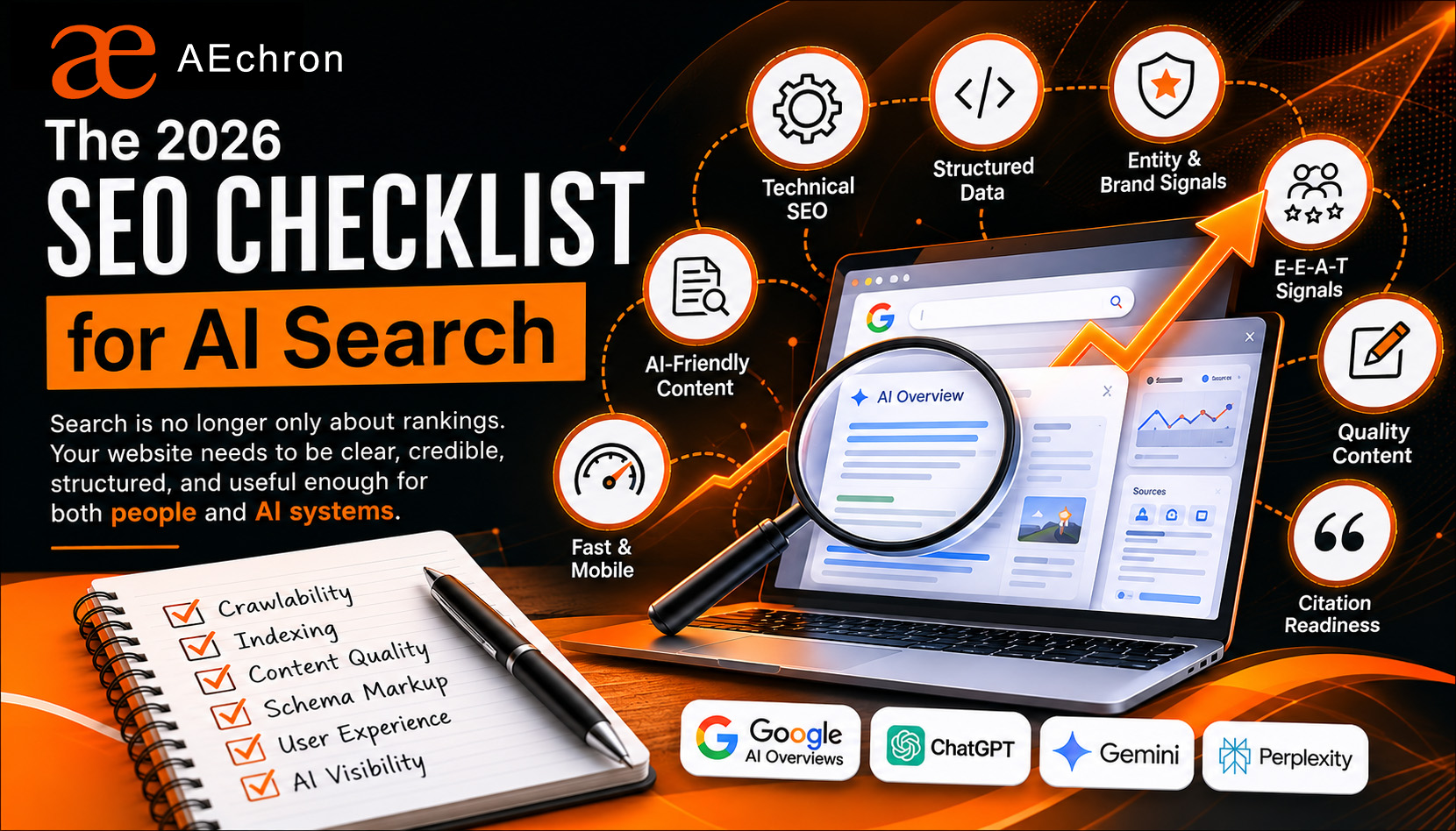
SEO in 2026 is not just about getting a blue link on page one. Search is becoming more conversational, more summarized, and more influenced by AI-powered results. Customers may discover your business through Google, AI Overviews, answer engines, maps, social platforms, videos, or third-party mentions.
That does not mean SEO is dead. It means SEO needs to become more complete.
At Aechron, we help businesses build SEO and AI-ready growth systems that make websites easier to find, understand, trust, and choose.
1. Clarify what each page is about
Every important page should have a clear purpose. A service page should explain the service, who it helps, where it is available, what problems it solves, and what action the visitor should take next.
Vague pages are harder for search engines, AI systems, and customers to understand.
2. Answer real customer questions
AI search often responds to full questions, not just short keywords. Your content should answer the questions customers ask before they contact you, compare options, or make a decision.
Use clear headings, direct answers, examples, and practical explanations.
3. Build topical depth
One page is rarely enough to show expertise. Build clusters of helpful content around your services, industries, locations, and customer problems.
For example, a business that offers SEO should have content about local SEO, technical SEO, AI search, content strategy, analytics, and common ranking problems.
4. Strengthen E-E-A-T signals
Experience, expertise, authoritativeness, and trust still matter. Show who is behind the content, why your business is credible, what experience you bring, and how customers can verify your claims.
Use case studies, testimonials, author information, service details, reviews, and clear contact information.
5. Improve technical SEO
AI-ready SEO still depends on the basics. Your site should be crawlable, indexable, fast, mobile-friendly, and easy to navigate.
If your technical foundation is weak, even strong content may struggle to perform.
6. Use structured data
Schema markup helps search engines understand your business, articles, FAQs, services, and local information. It gives your content clearer context.
Structured data is not a shortcut, but it supports better interpretation.
7. Earn mentions beyond your website
AI systems and modern buyers look beyond your own pages. Third-party mentions, directories, reviews, industry references, podcasts, guest features, and community conversations can all support trust.
Visibility is no longer only what you publish. It is also what others say about you.
8. Measure more than rankings
Rankings are useful, but they are not the whole story. Track impressions, clicks, calls, forms, qualified leads, branded search, assisted conversions, and pages that influence sales conversations.
The goal is not just to rank. The goal is to create business impact.
Your 2026 AI search checklist
- Give each important page one clear purpose.
- Answer customer questions in plain language.
- Build content clusters around services and problems.
- Add trust signals, author details, reviews, and proof.
- Fix technical SEO issues that block crawling or indexing.
- Use schema for articles, services, FAQs, and local business details.
- Earn mentions and credibility outside your own website.
- Measure leads, calls, pipeline, and revenue, not only rankings.
Make your website ready for modern search
Aechron helps businesses connect SEO, content, technical structure, and AI visibility into one practical growth plan.
Request a free SEO audit →