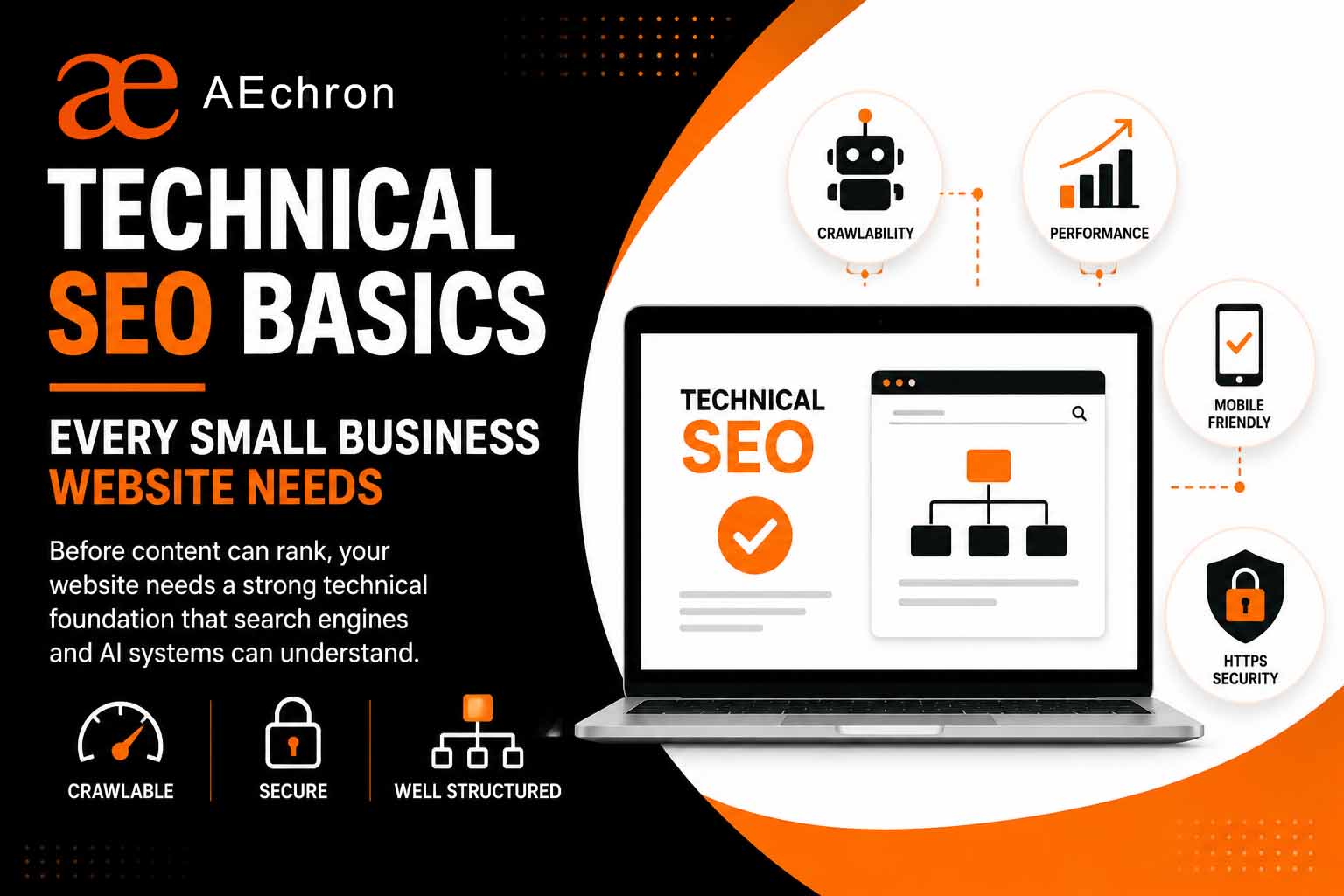
A small business website can have strong services, polished design, and helpful content, but still struggle to show up in search. Often, the issue is not the content itself. It is the technical foundation underneath it.
Technical SEO helps search engines crawl, understand, index, and trust your website. It also helps visitors load pages quickly, move through the site easily, and take action without frustration.
At Aechron, technical SEO is part of a broader SEO and AI growth strategy. The goal is not to chase every technical detail. The goal is to remove the barriers that keep good pages from being found.
1. Make sure search engines can crawl your site
If search engines cannot crawl your pages, they cannot rank them. Start by checking that important pages are not blocked by your robots.txt file, hidden behind broken navigation, or isolated with no internal links.
Your core pages should be easy to reach from the homepage, service pages, blog posts, and main navigation.
2. Keep your pages indexable
Crawling and indexing are not the same thing. A search engine may find a page but choose not to include it in search results if the page has technical issues, duplicate content, weak value, or a noindex tag.
Review your most important pages and make sure they are indexable, useful, and clearly connected to your business goals.
3. Improve page speed and mobile experience
Slow pages create friction. Visitors leave, forms get abandoned, and search engines receive weaker engagement signals. Large images, heavy scripts, and cluttered layouts are common problems.
Small businesses should focus on practical improvements: compress images, remove unnecessary plugins or scripts, use simple layouts, and test the website on a real phone.
4. Use clear site structure
A clear structure helps both people and search engines understand what your business offers. Each core service should have its own page, and related blog posts should link back to the service pages they support.
This creates a stronger path from helpful content to business action.
5. Write clean titles and meta descriptions
Page titles should describe the page clearly and include the language your customers actually use. Meta descriptions should explain why the page is useful and encourage the right people to click.
These basics still matter because they help search engines understand your page and help users decide whether to visit.
6. Add schema where it helps
Schema markup gives search engines extra context about your business, services, articles, FAQs, reviews, and local information. It does not guarantee rankings, but it can make your content easier to interpret.
For many small businesses, LocalBusiness, Organization, Article, FAQ, and Service schema are good starting points.
7. Fix broken links and redirect problems
Broken links create a poor experience and waste crawl paths. Redirect chains can slow users down and confuse search engines. Keep your internal links clean and make sure old pages redirect to the most relevant new page.
A simple technical SEO checklist
- Make important pages crawlable and indexable.
- Link core service pages from your homepage and navigation.
- Compress large images and improve mobile speed.
- Give each service a focused page.
- Use clear titles, headings, and meta descriptions.
- Add helpful schema markup.
- Fix broken links, duplicate pages, and redirect chains.
Find the technical issues holding your site back
Aechron can audit your website and turn technical SEO findings into a prioritized growth plan.
Request a free SEO audit →