SEO used to be easier to define. You researched keywords. You wrote pages. You fixed technical issues. You built links. If the page ranked, the work was working.
That version of SEO still matters, but it is no longer the whole game. People now discover businesses through Google Search, AI Overviews, ChatGPT, Perplexity, Gemini, social platforms, short-form videos, review sites, maps, and recommendation engines.
Search has become a larger visibility system. Winning today means showing up in more places, being understood by machines, earning trust from people, and turning attention into action.
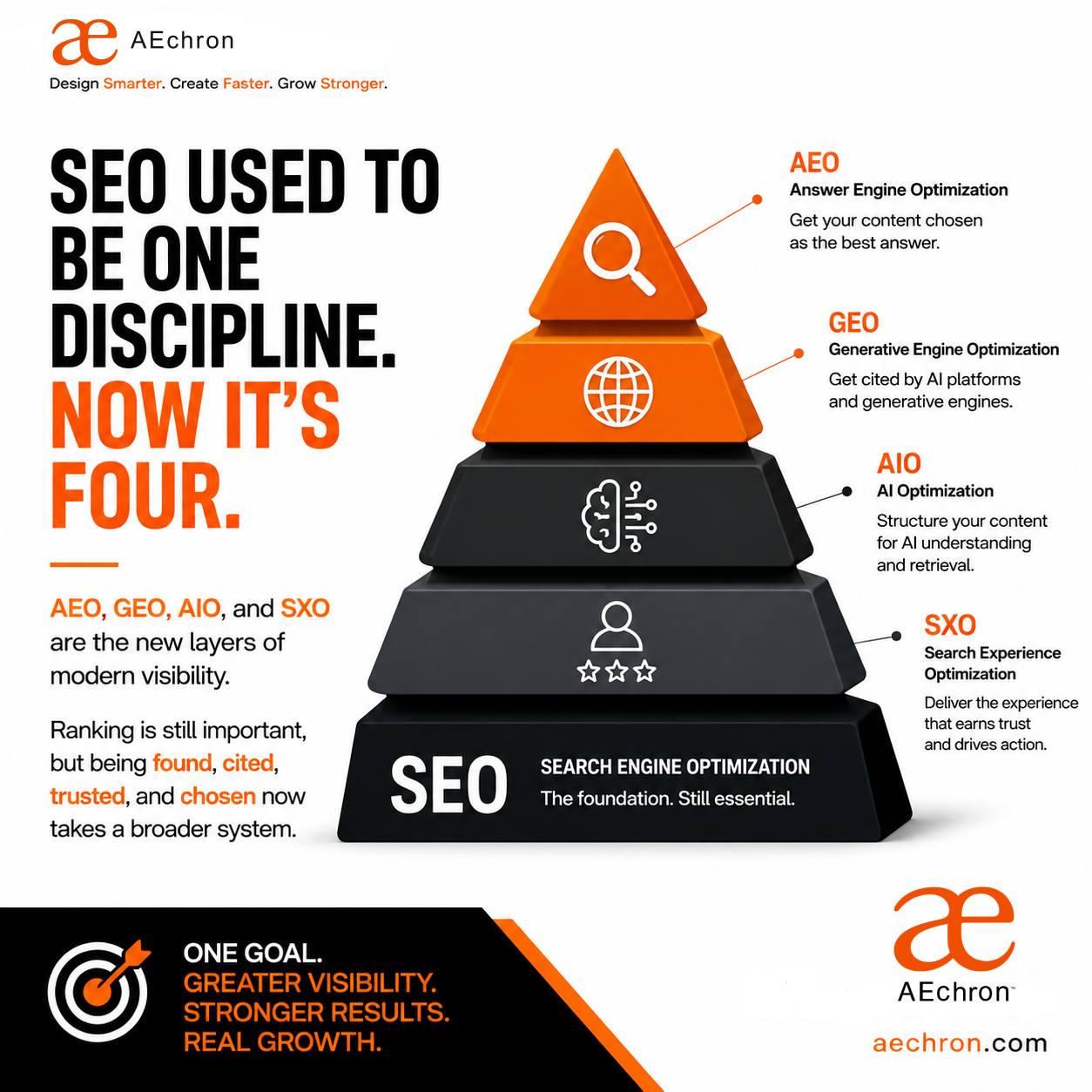
At AEchron, we help brands build AI-powered growth systems across the four layers of modern SEO: AEO, GEO, AIO, and SXO.
1. AEO: Get chosen in AI Overviews and instant answers
AEO stands for Answer Engine Optimization. It is the practice of structuring your content so search engines and answer engines can confidently use it for direct responses, featured snippets, voice search, People Also Ask results, and AI Overviews.
In traditional SEO, the goal was often to earn the click. In AEO, the first goal is to become the answer. Your content needs to be clear, specific, and easy to extract.
What AEO requires
- Clear definitions near the top of each section.
- Question-based headings that match real search behavior.
- Short answer blocks followed by deeper explanation.
- FAQ sections for high-intent questions.
- How-to structure for process-driven topics.
- Schema markup that helps machines understand the page.
- Accurate, current, and trustworthy information.
For example, a local accounting firm should not only write a page called "Small Business Tax Services." It should also answer questions like: What tax deductions can small businesses claim? When should a small business hire an accountant? How much does small business tax preparation cost?
Those answers help the firm appear when users search conversationally or when Google creates an instant answer.
2. GEO: Get cited by ChatGPT, Perplexity, Gemini, and AI search tools
GEO stands for Generative Engine Optimization. It focuses on earning visibility inside AI-generated responses from tools like ChatGPT, Perplexity, Gemini, Copilot, and other AI search experiences.
This is different from ranking on a classic search results page. In generative search, users may never see ten blue links. They ask a question and receive a synthesized answer. If your brand is cited, referenced, or recommended in that answer, you gain visibility. If you are missing, you may be invisible even if your website ranks somewhere on Google.
What GEO requires
GEO depends on authority, clarity, and source quality. AI systems are more likely to reference content that is specific, fact-rich, well structured, consistent across the web, supported by examples, and connected to a recognizable brand or expert.
The strongest GEO content does not simply repeat what every other article says. It adds information gain through original research, benchmarks, customer examples, industry analysis, comparisons, first-hand experience, clear frameworks, and practical checklists.
If ten articles all explain the same topic in the same way, AI systems have little reason to cite yours. GEO rewards content that gives the model something useful, credible, and distinct to work with.
3. AIO: Scale content with AI-enhanced workflows
AIO stands for AI Optimization. This does not mean publishing generic AI-written articles at scale. That approach creates noise, not authority.
AIO means using AI to improve the marketing workflow around research, planning, production, optimization, repurposing, and measurement. In other words, AIO helps the team move faster without lowering the quality bar.
What AIO can improve
- Topic clustering.
- Query fanout research.
- Content briefs.
- Competitive gap analysis.
- Internal link recommendations.
- Metadata drafts.
- Schema planning.
- Content refresh audits.
- Social post repurposing.
- Newsletter summaries.
- Video script outlines.
- Reporting and pattern detection.
The best use of AI is not replacing strategy. It is removing slow, repetitive work so humans can focus on judgment, originality, and customer insight.
A strong AIO workflow still needs editors, subject matter experts, brand guidelines, and fact-checking. AI can accelerate the system, but it should not be the final source of truth.
4. SXO: Turn visibility into action with fast, intent-matched UX
SXO stands for Search Experience Optimization. It connects SEO with user experience, conversion, and intent. The idea is simple: getting found is not enough if the page fails after the click.
If a visitor lands on your page and immediately feels confused, slowed down, distracted, or mismatched, the traffic was wasted.
What SXO requires
- Fast load times.
- Mobile-first layouts.
- Clear headings.
- Helpful above-the-fold content.
- Strong calls to action.
- Trust signals near decision points.
- Simple navigation.
- Minimal intrusive pop-ups.
- Content that matches the user's stage of awareness.
For example, someone searching "best AI SEO agency for startups" probably needs proof, positioning, services, case studies, pricing context, and a clear way to book a call. A vague blog post or slow generic services page will lose that visitor.
SXO turns visibility into pipeline.
How the four layers work together
The mistake is treating AEO, GEO, AIO, and SXO as separate tactics. They work best as one system.
AEO helps your content become the direct answer. GEO helps your brand get cited by AI search tools. AIO helps your team create and improve content faster. SXO helps visitors take action once they find you.
Together, they move a business from "we have SEO" to "we are visible, trusted, and converting across the modern search landscape."
The modern SEO checklist
- Add direct answer summaries under important headings.
- Turn common buyer questions into FAQ sections.
- Use schema where it fits the page type.
- Publish original insights, examples, or data.
- Make author and company expertise clear.
- Use consistent brand, service, and entity language across the site.
- Use AI for research support, briefs, content refreshes, and repurposing.
- Create quality controls before publishing AI-assisted content.
- Improve page speed and mobile usability.
- Make the next step clear on every important page.
- Add proof near calls to action.
What this means for businesses
The old SEO question was, "How do we rank?" The better question now is, "How do we become the most trusted answer wherever our customers are searching?"
That shift changes the work. Content needs to be useful to humans and readable by machines. Brand authority matters more. AI workflows can increase speed, but only if they are guided by strategy. User experience is part of search performance, not something separate from it.
SEO used to be one discipline. Now it is four. The companies that understand the difference will not just rank. They will get found, cited, trusted, and chosen.
Build a visibility system for modern search
AEchron helps startups and small businesses connect AEO, GEO, AIO, SXO, content, SEO, and conversion into one growth system.
Build your SEO plan →