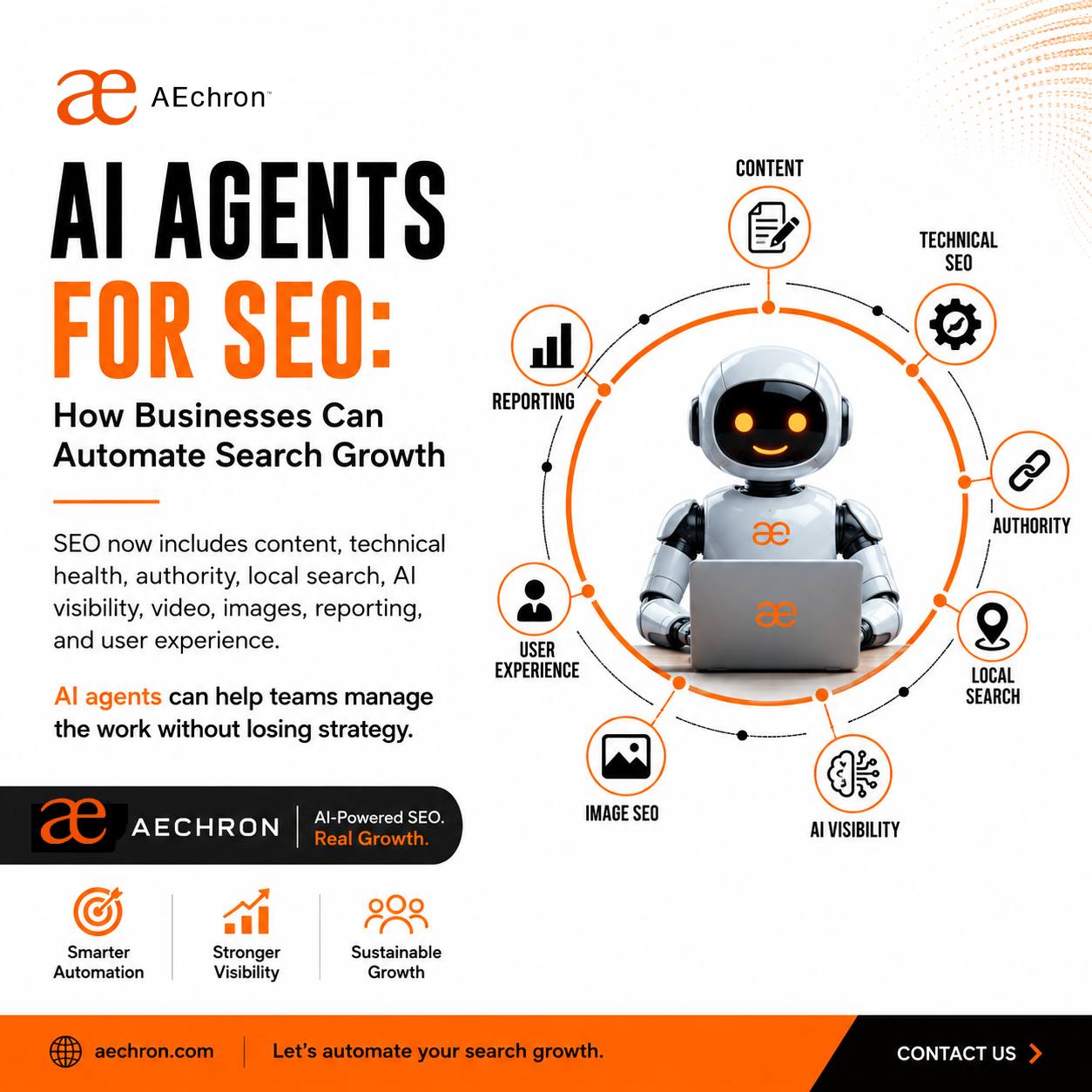
SEO used to be a list of tasks. Research keywords, write content, fix technical issues, build links, and track rankings.
Today, the work is much wider. Businesses need to show up in search results, AI answers, local packs, video platforms, image results, social search, featured snippets, and review-driven discovery. That means SEO teams have to monitor more signals, update more assets, and make decisions faster.
This is where AI agents can help.
An AI agent is a focused workflow that can research, check, summarize, draft, score, monitor, or recommend actions for a specific SEO task. The agent does not replace strategy. It helps remove repetitive work so humans can make better decisions. For businesses still building their tool stack, this connects closely with choosing the right AI SEO tools.
The image that inspired this article lists 50 possible AI agents for SEO. Here is how AEchron would organize those agents into a practical growth system for businesses.
1. Research and strategy agents
Good SEO starts with knowing what people search, what competitors are doing, and where the opportunity is. Tools like Ahrefs and Semrush can support that research, while agents can help organize the findings into next steps.
Research agents can help organize messy data into useful direction.
- Keyword clustering agent: groups related search terms into topics and content clusters.
- Search intent agent: identifies whether users want information, comparison, local help, pricing, or action.
- Striking distance agent: finds pages that are close to ranking higher and deserve priority updates.
- Topic gap agent: identifies missing topics your competitors cover but your site does not.
- Competitor delta agent: compares your content, links, and visibility against competitors.
- Forecast model agent: estimates which SEO opportunities may create the most business impact.
- SEO roadmap agent: turns findings into a prioritized plan.
These agents help teams move from guessing to prioritizing.
2. Content planning agents
Content still matters, but the bar is higher. Articles need to answer real questions, support AI visibility, match search intent, and help customers make decisions. That is why SEO now overlaps with AEO, GEO, AIO, and SXO.
Content planning agents can help create stronger briefs before writing begins.
- Content brief agent: outlines the page, headings, key questions, internal links, and target audience.
- Entity coverage agent: checks whether the content includes important people, products, places, concepts, and related terms.
- People also ask agent: finds common questions that should be answered clearly.
- Featured snippet agent: formats content so direct answers are easier for search engines to extract.
- Programmatic page agent: helps plan scalable pages for locations, services, comparisons, or product variations.
- Content QA agent: checks clarity, missing sections, duplication, formatting, and factual gaps.
- Content decay agent: finds pages losing traffic or freshness over time.
- Refresh priority agent: decides which old pages should be updated first.
The goal is not to publish more generic content. The goal is to publish better answers.
3. On-page optimization agents
Once content exists, it still needs structure. On-page agents help pages become easier for search engines, AI tools, and people to understand.
- Title CTR agent: improves titles for relevance and click-through rate.
- Meta rewrite agent: drafts better meta descriptions that match intent.
- Schema markup agent: recommends structured data for articles, FAQs, local business pages, products, reviews, and services using standards like Schema.org.
- Internal link agent: finds relevant internal links and anchor text opportunities.
- Anchor text agent: improves the language used in internal and external links.
- Image SEO agent: checks alt text, filenames, compression, and image relevance.
- Video SEO agent: helps optimize video titles, descriptions, transcripts, captions, and supporting pages.
These agents help turn raw content into search-ready assets.
4. Technical SEO agents
AI visibility still depends on a healthy website. If search engines cannot crawl, index, or understand your site, content performance will suffer. Tools such as Google Search Console, PageSpeed Insights, and Screaming Frog SEO Spider can help uncover the technical issues agents should monitor.
Technical agents can monitor site health and catch problems early.
- Technical audit agent: checks the site for technical SEO problems.
- Crawl budget agent: helps identify wasted crawling on low-value or duplicate URLs.
- Redirect chain agent: finds redirects that slow down crawlers and users.
- Canonical fix agent: checks whether canonical tags point to the right pages.
- Core web vitals agent: monitors speed, responsiveness, and layout stability.
- Log file analyzer: reviews how crawlers interact with the site.
- Index bloat agent: finds low-value indexed pages that may dilute quality.
- Sitemap hygiene agent: checks whether sitemaps are clean and current.
- 404 recovery agent: finds broken pages that should be redirected or restored.
- Pagination audit agent: reviews paginated pages for crawl and index issues.
- Hreflang checker agent: checks international targeting signals.
Technical SEO is not glamorous, but it protects every other SEO investment.
5. Authority and trust agents
Modern search rewards trust. AI search, Google rankings, local discovery, and conversion all depend on credibility signals. This is especially important as people compare businesses through search engines, AI tools, reviews, and social proof before they contact anyone.
Authority agents help businesses strengthen their public footprint.
- EEAT signal agent: checks for experience, expertise, authority, and trust signals.
- Author entity agent: improves author bios, credentials, and consistency.
- Digital PR agent: finds opportunities for expert quotes, mentions, and media coverage.
- Link prospecting agent: identifies relevant sites that may link or reference your content.
- Outreach writer agent: drafts outreach emails for partnerships and link opportunities.
- Toxic link agent: flags questionable backlinks for review.
These agents help support the bigger question: why should a search engine, AI tool, or customer trust this business?
6. Local SEO agents
For service businesses, local SEO is often where search becomes revenue. People want businesses near them, with proof, reviews, clear services, and easy contact options. A well-managed Google Business Profile is still one of the most important local visibility assets.
- Local SEO agent: checks local pages, city pages, citations, and location signals.
- GBP optimizer agent: improves Google Business Profile categories, descriptions, services, photos, and updates.
- Review response agent: drafts thoughtful review replies that support trust and local visibility.
Local SEO agents help small businesses stay visible where high-intent customers are looking.
7. Monitoring and reporting agents
SEO is not a one-time project. Rankings change. Algorithms change. Competitors publish. Pages decay. Traffic drops. New opportunities appear.
Monitoring agents help teams catch changes before they become bigger problems.
- Rank tracking agent: monitors keyword positions and movement.
- GSC query miner: finds useful search queries from Google Search Console data.
- Traffic drop detective: investigates sudden drops in traffic, clicks, or rankings.
- Algorithm watch agent: monitors performance changes that may align with search updates.
- Reporting agent: turns SEO data into summaries, priorities, and next steps.
- Orphan page agent: finds pages with no internal links pointing to them.
- Cannibalization agent: finds pages competing for the same query.
- SERP feature agent: tracks opportunities for snippets, local packs, videos, images, and other result types.
Good reporting should not just show numbers. It should tell the business what to do next.
How businesses should use AI agents
AI agents are most useful when they are tied to a clear process. A business does not need 50 disconnected tools. It needs a workflow.
A practical AI SEO workflow might look like this:
- Use research agents to find opportunities.
- Use content agents to create briefs and improve pages.
- Use technical agents to protect crawlability and speed.
- Use authority agents to strengthen trust signals.
- Use local SEO agents to improve nearby visibility.
- Use monitoring agents to track performance and catch issues.
- Use human strategy to decide what matters most.
The last step matters. AI can surface the issue. Humans still need to judge the business impact.
What AEchron can build for your SEO system
AEchron helps small businesses and startups turn SEO into a practical growth system, not a pile of disconnected tasks.
We can help with AI-assisted keyword research, content briefs, SEO blog posts, technical audits, internal linking, local SEO, Google Business Profile optimization, image SEO, video SEO, AI search visibility, reporting, and SEO roadmaps. That includes planning how your brand appears across tools like ChatGPT, Gemini, and Perplexity.
The goal is simple: use AI to move faster, use strategy to stay focused, and use content to help customers find and trust your business.
Final thought
AI agents will not replace SEO strategy. But they will change how SEO work gets done.
The businesses that win will not be the ones using the most tools. They will be the ones building the clearest systems: research, content, technical health, authority, local visibility, reporting, and conversion working together.
AI agents can help make that system faster. Strategy makes it useful.
Need an AI-assisted SEO system?
AEchron helps small businesses build practical SEO workflows for content, technical audits, local search, AI visibility, reporting, and growth.
Build your SEO system →