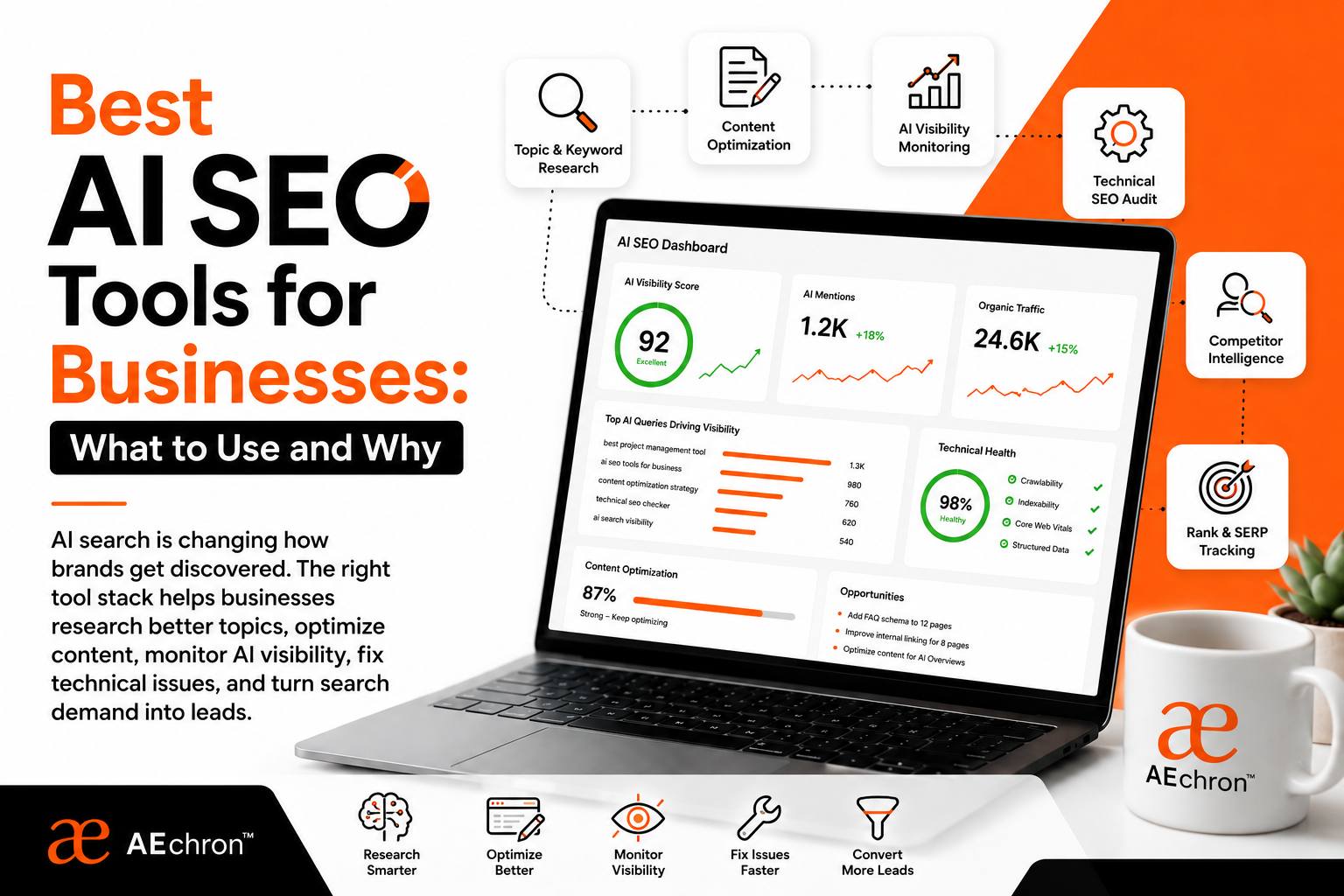
AI SEO tools are no longer optional for businesses that depend on search visibility. Customers are finding companies through Google, AI Overviews, ChatGPT, Perplexity, Gemini, social search, and comparison content. That means SEO teams need tools that can handle more than keywords and rankings.
The best AI SEO stack should help you answer four questions: What should we create? What should we improve? Where are we visible? What is stopping visitors from converting?
At AEchron, we help small businesses and startups build modern SEO and AI search systems that combine strategy, content, technical health, authority, and conversion. Here are the important AI SEO tools worth knowing.
1. HubSpot: Best for teams that want SEO, content, CRM, and AI together
HubSpot's SEO tools are useful for businesses that want SEO connected to content, marketing automation, reporting, and customer data. Instead of treating SEO as a separate dashboard, HubSpot helps teams connect content performance to the larger marketing system.
HubSpot has also moved into answer engine visibility with Content Hub, helping brands use AI-assisted workflows inside content planning and publishing.
Best fit: businesses already using HubSpot, teams that want content and CRM in one place, and companies that care about turning SEO traffic into leads.
2. Semrush: Best for SEO, competitor research, and AI visibility monitoring
Semrush is one of the most complete marketing platforms for keyword research, competitor analysis, content planning, technical checks, local SEO, advertising research, and rank tracking.
Its AI visibility features help brands measure how often they are mentioned in AI answers, benchmark against competitors, and find visibility gaps across AI search experiences.
Best fit: businesses that want a broad SEO and competitive intelligence platform, agencies managing multiple clients, and teams tracking both classic SEO and AI search visibility.
3. Ahrefs: Best for backlinks, content research, and AI-cited content workflows
Ahrefs has long been a favorite for backlink analysis, keyword research, competitor research, site audits, rank tracking, and content exploration.
The Ahrefs AI Content Helper helps teams match search intent, find topical gaps, improve relevance, and create content that has a better chance of being discovered by both search engines and AI chatbots.
Best fit: SEO teams that care deeply about links, competitive research, content gaps, and visibility across both search engines and AI answers.
4. Surfer: Best for content optimization and AI search scoring
Surfer is useful when you need to optimize articles around search intent, topical coverage, and content structure. Its Content Editor gives writers recommendations based on top-ranking pages and helps improve content before publishing.
Best fit: businesses publishing blog content regularly, content teams that want real-time optimization guidance, and marketers who need a repeatable workflow for improving articles.
5. Clearscope: Best for high-quality content optimization
Clearscope helps teams research, write, optimize, and monitor content for Google and AI search. It is especially useful for teams that want topical coverage without turning articles into keyword-stuffed pages.
Best fit: editorial teams, B2B content programs, SaaS companies, and businesses that want higher-quality search content with a strong optimization workflow.
6. MarketMuse: Best for content strategy and topic authority
MarketMuse is built for deeper content planning and topic authority. It helps teams analyze content inventories, find topic gaps, identify quick wins, create content plans, and improve pages based on topical coverage.
Best fit: companies with larger content libraries, content strategists, publishers, agencies, and teams trying to build authority across topic clusters.
7. Screaming Frog: Best for technical SEO audits
Screaming Frog SEO Spider is a technical SEO crawler that helps teams audit website health. It can identify issues with titles, meta descriptions, headings, canonicals, redirects, broken links, status codes, structured data, internal links, and more.
AI SEO still depends on technical SEO. If your site is difficult to crawl, poorly structured, slow, or full of broken pages, AI search optimization will not fix the foundation.
8. Google Search Console and Bing Webmaster Tools: Best free essentials
Google Search Console is still one of the most important SEO tools because it shows how Google sees your website. It helps you monitor indexing, search queries, clicks, impressions, technical issues, sitemaps, and page experience signals.
Bing Webmaster Tools is also worth setting up, especially as Microsoft search experiences connect more deeply with AI-powered discovery.
9. ChatGPT, Perplexity, and Gemini: Best for manual AI search testing
Tools like ChatGPT, Perplexity, and Gemini are not traditional SEO platforms, but they are useful for manual visibility checks.
Ask the same questions your customers would ask. See which companies get mentioned, which sources are cited, what language AI tools use, and whether your brand appears at all.
How to choose the right AI SEO tool stack
Most businesses do not need every tool. They need the right combination for their stage, team, and goals.
- For a simple small business stack: Google Search Console, Bing Webmaster Tools, Screaming Frog, and one content optimization tool.
- For a growth-focused startup stack: Semrush or Ahrefs, Google Search Console, a content optimizer, and manual AI search testing.
- For a HubSpot-based marketing team: HubSpot SEO, HubSpot Content Hub, Google Search Console, and Semrush or Ahrefs for competitive research.
- For an agency stack: Semrush, Ahrefs, Screaming Frog, Clearscope or Surfer, Google Search Console, and AI visibility tracking.
- For a mature content team: MarketMuse, Clearscope, Ahrefs or Semrush, technical crawling, and structured content refresh workflows.
The tool is not the strategy
AI SEO tools can make research faster, content better, and visibility easier to measure. But tools do not replace strategy.
A business still needs clear positioning, strong service pages, useful content, technical health, authority signals, trust-building proof, and conversion-focused user experience. The tool helps you see the work. It does not do the thinking for you.
The winning stack is the one your team will actually use every week to make better decisions.
Final thought
AI SEO is not about chasing every new platform. It is about building a system that helps your business get found in search, cited in AI answers, trusted by buyers, and chosen when people are ready to act.
Start with the basics. Add tools only when they solve a real workflow problem. Then use them consistently to improve content, technical performance, authority, and conversions.
Build the right AI SEO stack
AEchron helps small businesses and startups choose the right SEO tools, build better content systems, improve technical visibility, and turn search traffic into leads.
Plan your SEO stack →