Small business owners are hearing more search terms than ever: SEO, AEO, GEO, AI search, answer engines, and generative search. It can feel like every month brings a new thing to fix.
The good news is that these ideas are connected. You do not need to throw away traditional SEO. You need to build on it with clearer content, stronger website structure, and better answers to the questions customers are already asking.
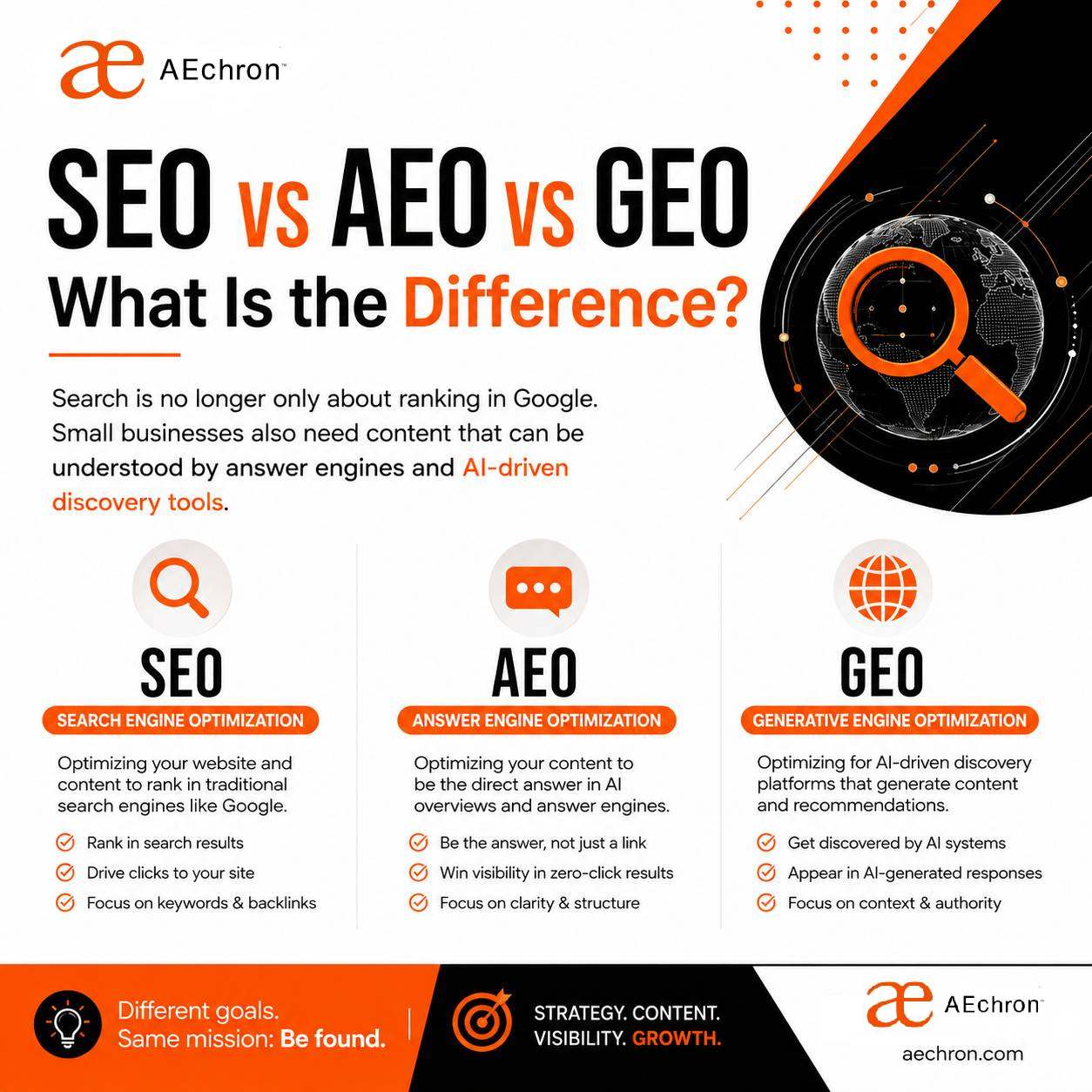
SEO helps people find your website in search results. AEO helps your content answer direct questions. GEO helps AI-driven tools understand, summarize, and reference your business. Together, they support modern search visibility.
What Is SEO?
SEO stands for search engine optimization. It is the work of making your website easier for search engines and people to understand.
For a small business, SEO usually includes clear service pages, helpful website content, strong page titles, meta descriptions, internal links, fast loading pages, local signals, and technical structure that allows search engines to crawl the site.
SEO is still the foundation. If your website is vague, slow, hard to navigate, or missing important service information, AEO and GEO will not fix the larger problem. A technical SEO foundation gives every other search strategy something solid to build on.
What Is AEO?
AEO stands for answer engine optimization. It focuses on helping your content answer specific questions clearly enough to appear in answer-style results.
This matters because people do not always search with short keywords anymore. They ask full questions. They compare services. They want quick explanations, checklists, pricing factors, and next steps.
AEO-friendly content is organized around real questions. It uses clear headings, direct answers, useful examples, and plain language. It also avoids hiding important information behind vague marketing copy.
For example, a business might publish an article that answers “Do I need a blog for SEO?” or “Why is my website not ranking?” That kind of helpful blog content gives answer engines more context and gives customers a better reason to trust the business.
What Is GEO?
GEO stands for generative engine optimization. It is the work of making your business easier for AI-driven search tools to understand and mention when they generate answers.
GEO is not about tricking AI tools. It is about making your website clear, credible, and easy to interpret. That includes consistent business information, strong service descriptions, structured pages, useful content, schema markup, sitemap access, and clear signals about who you help.
AI-driven tools look for patterns, authority, usefulness, and context. If your website explains your services clearly, connects related pages, and answers real customer questions, it has a better chance of being understood correctly.
How SEO, AEO, and GEO Work Together
SEO, AEO, and GEO should not be treated as three separate projects. They work best as one search visibility system.
-
SEO builds the foundation
Your website needs crawlable pages, strong service information, metadata, internal links, technical structure, local signals, and content that matches search intent.
-
AEO improves the answers
Your content should answer customer questions clearly, especially questions about services, pricing, process, comparisons, problems, and decision-making.
-
GEO improves AI understanding
Your website should make it easy for AI-driven search tools to understand what your business does, who you serve, what you offer, and why your content is trustworthy.
This is why small businesses should avoid chasing every new search trend separately. The better approach is to make the website clearer, more useful, and more connected.
What Should Small Businesses Fix First?
If you are not sure where to start, begin with the parts of your website that help both people and search systems understand your business.
-
Clarify your main services
Each important service should be easy to find and understand. Explain what the service is, who it helps, what problems it solves, and what the next step is.
-
Answer common customer questions
Use your sales calls, emails, consultations, and repeated customer questions as content ideas. Those questions are often search opportunities.
-
Connect related pages
Internal links help visitors move through your site and help search engines understand which pages belong together. This is especially useful when building topic authority.
-
Add technical trust signals
Metadata, schema, sitemap files, robots.txt, page speed, mobile usability, and clear headings all help search systems process your website with less confusion.
Do You Need All Three?
Most small businesses do not need to think of SEO, AEO, and GEO as separate purchases. They need a practical search strategy that includes all three ideas.
Traditional SEO still matters because Google search is still important. AEO matters because search results are becoming more answer-based. GEO matters because AI-driven discovery is becoming part of how people research services, compare options, and make decisions.
The goal is not to chase a label. The goal is to make your business easier to find, easier to understand, and easier to trust.
Related Reading
- Google Search Central: Creating helpful, reliable, people-first content
- How to Rank When Google Answers Before the Click
- SEO Isn’t Dead. It’s Becoming AI-Ready.
- SEO and search visibility services
Need help making your website search-ready?
AEchron helps small businesses and startups improve website structure, content clarity, SEO, AEO, GEO, and practical search visibility systems.
Plan your search strategy →